

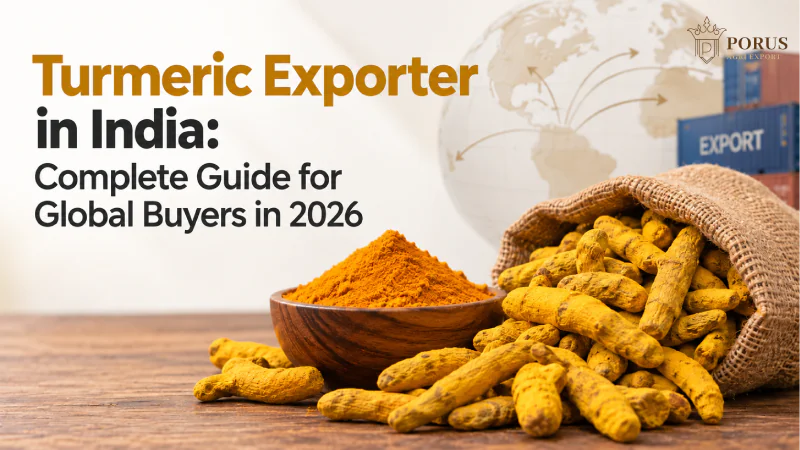
Turmeric Exporter in India: Complete Guide for Global Buyers in 2026
Key Takeaways
- Understanding specific turmeric varieties and curcumin levels is essential for effective sourcing from Turmeric Exporters in India.
- Clearly defined parameters like moisture content and packaging are vital for global buyers when purchasing turmeric.
- Porus Agri Export caters to diverse applications, offering polished turmeric fingers and bulbs from various Indian regions.
- Communicating your application needs will streamline the procurement process with a Turmeric Exporter in India.
- Export documentation plays a critical role in international transactions; ensure clarity on all required papers.
Porus Agri Export a leading exporter of turmeric.
For international importers, spice processors, distributors and food manufacturers, buying turmeric is not simply about choosing a supplier. Variety, curcumin level, moisture, processing, packaging and export documentation can directly affect suitability for the intended application. Working with an experienced Turmeric Exporter in India helps global buyers source turmeric according to clearly defined commercial requirements.
In 2026, buyers need a procurement approach that starts with specifications rather than general descriptions such as premium or high quality. Indian turmeric is available for spice grinding, seasoning, food manufacturing and nutraceutical-related applications, making product selection an important part of the buying process.
Understanding Indian Turmeric for Global Procurement
Turmeric purchased for international B2B requirements may differ according to variety, physical form and curcumin requirement. Our export range includes polished turmeric fingers and bulbs, with Sangli, Nizamabad and Salem among the available varieties.
Curcumin levels typically range from 2% to 5%, depending on the selected variety. Moisture is specified at a maximum of 10%, while the turmeric is machine-polished and supplied with a bright natural colour and low admixture.
These specifications give buyers a practical starting point when discussing their requirements with a Turmeric Exporter in India. Instead of sourcing solely by appearance, procurement teams can define the characteristics needed for their processing or distribution operation.
Key Turmeric Specifications Buyers Should Review
Before confirming a bulk requirement, buyers should clearly communicate the intended application and required product parameters.
Important specification points include:
- Product form: polished turmeric fingers or bulbs
- Varieties: Sangli, Nizamabad and Salem
- Curcumin content: typically 2–5%
- Moisture: maximum 10%
- Processing: machine-polished
- Appearance: bright natural colour with low admixture
Different buyers may place different importance on these parameters. A spice grinder may prioritise grinding suitability and colour, while a nutraceutical buyer may pay closer attention to the required curcumin range.
The main procurement takeaway is to approve measurable product specifications before confirming a commercial shipment.
Why Curcumin Content Matters to Global Buyers
Curcumin is one of the primary specification points used when selecting turmeric for different applications. A buyer sourcing turmeric for general spice processing may have different requirements from a business purchasing raw material for curcumin-focused applications.
The turmeric offered by Porus Agri Export is available with curcumin levels typically ranging from 2% to 5%, depending on variety.
For buyers, this means the required curcumin level should be discussed during the inquiry stage rather than after shipment planning begins. Working with a Turmeric Exporter in India that communicates available grades clearly makes it easier to match the product specification with the intended commercial use.
Packaging and Bulk Shipment Options
Packaging matters because international turmeric orders involve bulk handling, storage and onward distribution. The turmeric product range is available in 25 kg and 50 kg PP or jute bags, while the technical specification also identifies 50 kg PP bags as a standard packaging format.
For standard bulk orders, the website states that a typical minimum order is approximately one 20-ft FCL, around 19 MT. Trial orders, LCL shipments and samples can also be discussed based on the requirement.
Buyers should confirm packaging type, bag weight, quantity, product grade and destination before finalising shipment terms.
Export Shipping and Documentation
International agricultural procurement requires more than the physical commodity. Buyers also need the commercial and shipment documents associated with the order.
Porus Agri Export ships through Mundra and Kandla ports in Gujarat and offers FOB, CIF and CFR terms, with EXW available on request. Export documentation can include Commercial Invoice, Packing List, Bill of Lading, Certificate of Origin, Shipping Bill, Certificate of Analysis, Phytosanitary Certificate and Fumigation Certificate, while a Health Certificate is available on request.
Clear documentation planning is especially important for buyers working with different destination markets because document requirements can depend on the shipment, product and importing country.
How Global Buyers Can Plan a Turmeric Order
A structured sourcing process helps reduce specification gaps between the buyer and exporter.
- Define the application: Specify whether the turmeric is required for spice grinding, seasoning, food manufacturing, distribution or another commercial application.
- Confirm the variety and form: Discuss whether polished fingers, bulbs and a particular variety are required.
- Set quality parameters: Confirm curcumin range, moisture requirement and other agreed specifications.
- Approve packaging and quantity: Select the appropriate bag type, pack size and shipment quantity.
- Confirm shipping terms and documents: Finalise Incoterms, loading port and required export documentation before dispatch planning.
This process gives both buyer and supplier a clear commercial specification to work from.
Buyer Checklist Before Confirming a Supplier
When evaluating a Turmeric Exporter in India, procurement teams should verify the product and shipment details most relevant to their business.
- Confirm available turmeric varieties and product form
- Specify the required curcumin range
- Check the agreed moisture parameter
- Confirm packaging type and bag size
- Discuss MOQ or trial-order requirements
- Confirm shipping terms and export documents
- Request a sample or product specification where required
This checklist is especially useful when comparing quotations from different suppliers because it keeps the evaluation focused on comparable requirements rather than broad quality claims.
Export Capability for International Buyers
The company states that it exports agricultural commodities to more than 25 countries and holds Government of India DGFT One Star Export House recognition, with the status shown as valid from 2026 to 2031. Its IEC is listed as AAYFP1436F.
For turmeric specifically, the website identifies markets including Europe, the UAE and the USA, alongside broader export activity to international destinations.
For buyers, these capabilities are most useful when combined with clear communication about specifications, shipment terms and documentation before placing a bulk order.
Why Choose Us
At Porus Agri Export, we work with international buyers who need clearly specified Indian turmeric for bulk commercial requirements. Our turmeric range includes polished fingers and bulbs, Sangli, Nizamabad and Salem varieties, selectable curcumin levels and export-oriented packaging. We also support buyers with samples, shipment planning and relevant export documentation. Our approach is focused on understanding the buyer's required grade, application, quantity, packaging and destination so that the commercial order is built around defined procurement requirements.
Conclusion
Selecting the right Turmeric Exporter in India requires more than finding a source of Indian turmeric. Global buyers should evaluate variety, curcumin content, moisture, physical form, packaging, quantity, shipping terms and documentation before confirming an order. Indian turmeric varieties such as Sangli, Nizamabad and Salem can serve different B2B applications when specifications are selected correctly. Porus Agri Export supports international importers, distributors, processors and commercial buyers with bulk turmeric supply based on defined product and shipment requirements.
Looking to source export-grade Indian turmeric for your business?
Contact Porus Agri Export to discuss your required turmeric variety, curcumin level, packaging, quantity and destination. Ask our team about bulk requirements, available samples and export shipment options.
Call: +91 98250 40085
Email: info@porusagriexport.com
Frequently Asked Questions
What should global buyers consider when selecting a Turmeric Exporter in India?
Global buyers should evaluate the turmeric variety, curcumin content, moisture levels, and packaging options when selecting a Turmeric Exporter in India. It's important to define the specific application requirements to ensure the turmeric meets their commercial needs.
Why is curcumin content important in turmeric?
Curcumin content is crucial as it determines the health benefits and suitability for various applications. Different buyers may have specific curcumin level requirements based on their intended use, such as spice processing or nutraceutical production.
What are the common turmeric varieties exported from India?
Common turmeric varieties exported from India include Sangli, Nizamabad, and Salem. Each variety may have different characteristics, such as curcumin content and suitability for specific applications.
What packaging options are available when buying turmeric from Indian exporters?
Turmeric is typically packaged in 25 kg and 50 kg PP or jute bags, with 50 kg PP bags being a standard format. Buyers should confirm their preferred packaging type and quantity during the order process.
How can buyers ensure compliance with export documentation when sourcing turmeric?
Buyers should discuss and confirm all necessary export documentation, including the Commercial Invoice, Certificate of Origin, and Phytosanitary Certificate, with their Turmeric Exporter in India. Proper documentation planning is essential to meet the requirements of the destination market.

Recent Posts


+91 98250 40085
info@porusagriexport.com